

What Does Uncuymaza Mean? Tracing a Puzzling Search Term
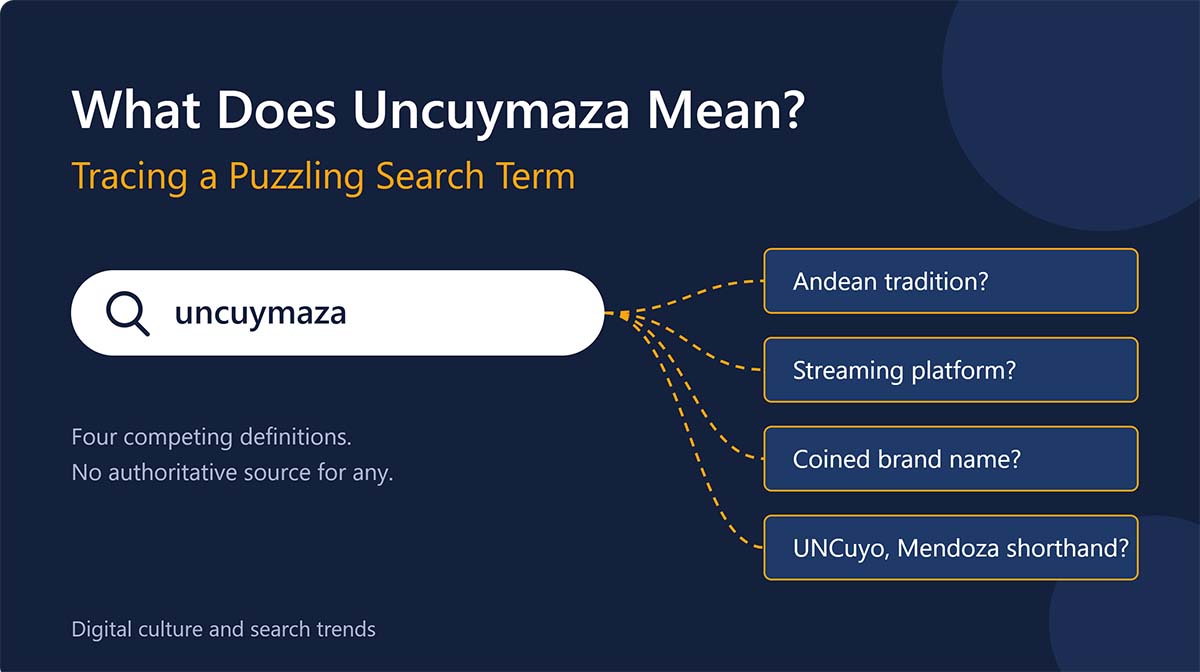
Search for uncuymaza and you will meet a crowd of confident explanations that rarely agree. One page calls it an ancient Andean practice, another a lost city, another an entertainment platform, and another simply a brand waiting for an owner. This article follows those claims back to their sources, tests what can be tested, and explains what the evidence supports as of November 2026.
The honest short answer is that no dictionary, university, or official body defines the word. What does exist is a pattern worth understanding, because it shows how the modern web can manufacture meaning around a string of letters.
What the Search Results Actually Show
The pages that rank for this word are almost entirely blogs and content sites, many dated between 2025 and 2026. I found no dictionary entry, no academic paper, no report from an established news outlet, and no government or institutional page that treats the word as an established term.
That alone does not prove a term is meaningless. New names, projects, and slang often appear before reference works catch up. But it changes how the results should be read. When nobody authoritative has weighed in, every confident definition is a claim to examine, not a fact to repeat. Not one of the pages I reviewed cites a primary source for its own version of uncuymaza, such as an archaeological record, a company filing, or a named speaker of the language it invokes.
Four Competing Explanations for Uncuymaza
The conflicting definitions fall into four camps. Each deserves a fair hearing.
The Andean tradition story
Several articles present the term as a pre-colonial Andean practice rooted in Quechua culture and centered on reciprocity with Pachamama, or as a hidden sacred city known through oral tradition. Oral history is a legitimate way of preserving knowledge, so the form of the claim is not the problem. The problem is the absence of anything checkable: no named community, no Quechua speaker or linguist, no historian or archaeologist. Attaching an unverified practice to indigenous peoples also carries a real cost, because it can distort public understanding of their actual traditions.
The streaming platform story
One site describes the term as a digital entertainment platform offering series and films. My searches turned up no official website, company, or app listing matching that description. That is hard to square with a service said to have gained significant attention.
The coined brand reading
A third group takes the opposite approach. It admits the word has no traditional definition and suggests it may be a brand, a startup concept, or an online identity. This is the most cautious reading and the hardest to disprove, mainly because it commits to almost nothing. Whoever owns uncuymaza, if anyone does, has not made themselves known.
The UNCuyo shorthand
The fourth explanation connects the term to Argentina’s National University of Cuyo in Mendoza. It is the only one tied to a real, verifiable institution, so it gets its own section below.
Could It Be a Garbled Reference to UNCuyo?
The Universidad Nacional de Cuyo, usually written UNCuyo, is a public university in Mendoza, Argentina, and the largest center of higher education in that province. It was created in 1939 by national decree number 26971 to serve the Cuyo region, which covers the provinces of Mendoza, San Juan, and San Luis. The universities of San Juan and San Luis later became independent institutions.
Sources disagree on the day. Argentine press and reference pages commonly give March 21, 1939 as the date of the decree, while the university’s English-language history page lists August 16, 1939, a date local media also treat as the institution’s birthday. Both agree on the year. You can read the university’s own account on its official history page.
Why would a university produce this keyword? Look at the letters. UNCuyo is the institution’s common name, and “Mza.” is a familiar abbreviation for Mendoza. Run them together in a hurried search and you get something close to uncuymaza. At least one article makes this argument, describing the term as an informal shorthand. It is a plausible explanation and the easiest to test, but I found no official statement or search data confirming it, so it remains a hypothesis.
Why Terms Like Uncuymaza Spread Without Meaning
A word with no history and no competition is attractive to anyone producing content at volume. A page that defines it first can rank easily, and later pages tend to follow the same framing instead of checking it. The result is a closed loop in which repetition stands in for evidence. That is a likely mechanism, not a proven one, since there is no way to see who commissioned these pages.
The writing itself offers clues. Phrases such as emerging concept, rising topic, and digital potential recur across the pages, yet none of them says what the concept actually is. Text built around a keyword rather than a subject tends to sound like this: fluent, upbeat, and empty. When two pages define the same word as an Andean ritual and a streaming service, at least one was written without knowing the answer, and possibly both.
None of this is unique. Typos, abbreviations, and coined strings routinely become minor search trends, and each is quickly wrapped in explainer content. Uncuymaza is simply a clear and recent example.
How to Check a Mystery Term Before You Trust It
A few habits make these situations easier to navigate.
- Look for a primary source: A dictionary entry, a company registry record, an institution’s own website, or a named scholar counts. A blog summarizing another blog does not.
- Compare the definitions: If sources contradict each other about the basic nature of a thing, treat all of them cautiously.
- Check for a real-world footprint: A genuine service usually has an official domain, a legal entity, and often an app store listing. The age of a domain registration can also be informative.
- Try plausible corrections: Misspellings and merged abbreviations explain many odd searches, as the UNCuyo possibility shows.
- Be wary of cultural claims: If a page attributes a tradition to a specific people, look for voices from that community or published scholarship.
If a site built around uncuymaza asks for logins, payments, or downloads, the lack of verifiable ownership is reason enough to stop.
Frequently Asked Questions
Is uncuymaza a real word?
It does not appear in any dictionary or authoritative reference I could find. It is best treated as an unverified term whose meaning changes depending on who is writing.
Does it have a Quechua or Andean origin?
No verified evidence connects it to Quechua or Andean culture. The claims come from low-authority websites that cite no scholarship, speakers, or named communities.
Could it be a mistyped form of UNCuyo Mendoza?
Possibly. The letters line up neatly, but there is no official confirmation. Treat it as the most plausible explanation, not the established one.
Are sites about uncuymaza safe to use?
Safety depends on the specific site, not the word. Prefer pages with clear ownership, secure connections, and a stated privacy policy, and avoid entering personal or payment details on any page you cannot verify.
Also Read: Mindset Energy
Conclusion
Uncuymaza is best understood not as an ancient tradition, a platform, or a brand, but as a reminder that a confident explanation online is not the same as a verified one. The only link to something real is the possible UNCuyo and Mendoza connection, and even that is unconfirmed. When a strange term arrives with competing stories, the most useful move is to trace each claim to its source and accept “unknown” as an answer until one holds up.